Adriano Olivetti biography
 |
Adriano Olivetti was born in Ivrea on 11 April 1901. His engineer father, Camillo, an eclectic and original thinker, founded "Italy's first typewriter factory" in Ivrea in 1908. During his formative years, Adriano developed a keen interest in social and political debate, moving in liberal reformist circles and writing for the reviews "L'azione riformista" and "Tempi nuovi". Piero Gobetti and Carlo Rosselli were important influences.
After graduating in industrial chemistry at the Politecnico di Torino, in 1924 Adriano began an apprenticeship as a factory worker in the family business. The following year, accompanied by Domenico Burzio, he toured the USA, visiting dozens of factories. On his return, he drew up a wide-ranging programme of innovative projects to modernise operations at Olivetti: a decentralised staff organisation, function-based management, rationalisation of assembly work, development of the Italian and overseas sales network, etc. He subsequently launched work on a project for the first portable typewriter, which was launched in 1932 as the MP1.
The new organisation led to a significant improvement in productivity and sales. In 1931 Adriano travelled to the USSR with a delegation of Italian industrialists. The same year, he set up an Advertising Department in Olivetti, which immediately began working with major artists and designers; the following year, he formed the Organisation Office.
At the end of 1932, Adriano Olivetti was appointed General Manager; in 1938 he became company Chairman, taking over from his father Camillo. He continued his analyses and experiments in working methods, and published essays dealing with technology, economics and industrial sociology in "Tecnica e Organizzazione", a journal he himself had founded.
Adriano Olivetti's polyhedric personality led him to broaden his activities from industry and business to a wider sphere including urban planning, architecture, culture, and social and political reform. In Ivrea, he launched projects for the construction of new production facilities, offices, employee housing, canteens, nurseries, developing a complex system of social services. In 1937, for example, he commissioned the construction of a residential housing estate for company employees, designed by architects Figini and Pollini.
For Adriano Olivetti, territorial organisation and architecture had an enormous importance at the social and economic levels. In 1938 he joined the "Istituto Nazionale di Urbanistica" and in 1948 became a member of the institute's Steering Council. In 1949 he personally financed the revival of the review "Urbanistica". As head of the Institute supported by a team of young architects (including Ludovico Quaroni), from 1950 Adriano was able to develop his views on the political primacy of Urban Planning.
Reflecting the great importance Adriano Olivetti placed on the company's relationship with the territory, in 1937 he took part in the preparatory work for a planning scheme for the Aosta Valley, and in 1951 he worked with the Ivrea city authorities on the launch of a new urban plan.
In 1956 Olivetti was made an honorary member of the American Institute of Planners and deputy chairman of the International Federation for Housing and Town Planning; in 1959 he was appointed chairman of Italy's "Istituto UNRRA-Casas", an institute for post-war reconstruction.
The many awards received by Adriano Olivetti included, in 1955, the Compasso d'Oro for achievements in industrial aesthetics and, in 1956, the Gran Premio di architettura for "the architectural merit, original industrial design, social and human objectives incorporated in every Olivetti achievement".
After the Second World War, Adriano Olivetti intensified his activities as a publisher, writer and intellectual. Together with a group of young scholars, he had already formed a new publishing house, NEI (Nuove Edizioni Ivrea), which became Edizioni di Comunità in 1946. The house published major works in a number of cultural fields, including political thought, sociology, philosophy, organisation of labour, introducing many radical thinkers and distinguished foreign writers to the Italian public.
During his exile in Switzerland (1944-1945), Olivetti completed work on his book "L'ordine politico delle comunità" (the political order of communites), which was published at the end of 1945 by NEI. The volume illustrates the fundamental concepts of the Movimento Comunità, the movement founded by Adriano Olivetti in 1947, and his proposals to stimulate the creation of new political, social and economic ties between central and local governments. The "Comunità" magazine, founded in 1946, became the key cultural reference of the Movimento Comunità. At the end of 1959, Edizioni di Comunità published a collection of essays by Adriano Olivetti entitled "Citta dell'Uomo" (the human city).
In order to translate his community ideas into reality, in 1955 Adriano Olivetti founded the IRUR institute for the urban and rural renewal of the Canavese, the area around Ivrea, as a tool to combat local unemployment by promoting new industrial and agricultural ventures. The following year, the Movimento Comunità ran for the local elections and Adriano Olivetti was elected mayor of Ivrea. This success led Movimento to present candidates for the national elections in 1958, but only Adriano Olivetti won a seat.
Urban planner, publisher, writer, intellectual; first and foremost, however, Adriano Olivetti was an industrialist and entrepreneur who regarded the enterprise as the key driver of economic and social growth.
Under his guidance, the Olivetti company worked to achieve technological excellence, innovation and international leadership, and at the same time strengthened its focus on industrial design and improved living standards for its employees.
In 1948, the Ivrea plants formed a Works Council (Consiglio di Gestione), for many years the only such body in Italy, with general consultative powers on funding for social services and welfare. In 1956, ahead of national employment contracts, the Olivetti company reduced the working week from 48 to 45 hours, on an unchanged wage basis. Employee housing estates were built, as well as new premises for the social services department, the library and the canteen. Many leading architects worked on these projects: Figini, Pollini, Zanuso, Vittoria, Gardella, Fiocchi, Cosenza, etc.
In the industrial design field, too, Adriano Olivetti called some of the country's top talents, including Marcello Nizzoli and - later - Ettore Sottsass. Between the end of the 1940s and the end of the 1950s, the company launched a number of products that would become cult objects in terms of design, technological content and functionality: these included the Lexikon 80 typewriter (1948), the Lettera 22 portable typewriter (1950), the Divisumma 24 calculator (1956). In 1959, an international jury of designers named the Lettera 22 as the best of the one hundred top products of the previous 100 years.
Graphics and advertising were also a prime concern and the company became a worldwide reference model for its work in the industrial design field.
As the Olivetti product range broadened, production capacity was expanded to meet growing demand on the Italian and international marketplaces. In Italy, the company opened factories in Pozzuoli and Agliè (1955), S. Bernardo di Ivrea (1956), Ivrea (the "new ICO") and Caluso (1957). In Brazil, a new facility opened in São Paulo in 1959.
The outstanding success of the company's office products on the international marketplace did not distract Adriano Olivetti's attention from developments in the new field of electronics. As early as 1952, the Olivetti company opened an electronic computer research laboratory, in New Canaan, USA. In 1955, it formed the electronic research laboratory in Pisa; in 1957, together with Telettra, Olivetti founded the Società Generale Semiconduttori (SGS) company and in 1959 launched the Elea 9003, Italy's first electronic computer, developed and manufactured at the Borgolombardo laboratory.
In 1957 Adriano Olivetti's entrepreneurial achievements won further recognition when the National Management Association of New York awarded him a prize for "ground-breaking activity in the field of international company management".
In 1959 Adriano Olivetti signed an agreement for the acquisition of Underwood, a US organisation with almost 11,000 employees, which had been the inspiration for his father Camillo when he formed the Olivetti company in 1908.
Adriano Olivetti died suddenly on 27 February 1960, during a train journey from Milan to Lausanne. He left a business enterprise with operations on all the major international markets and 36,000 employees, of whom more than half overseas.
Camillo Olivetti biography

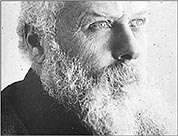
Camillo Olivetti was born in Ivrea in August, 1868. He attended the Politecnico di Torino, where he studied under Galileo Ferraris.
An eclectic and original personality, after graduating in engineering Olivetti spent some time in London, where he gained experience as a factory worker. He joined the socialist party and developed a keen interest in federalism, local autonomy and democratic institutional reform.
In 1893, he accompanied Galileo Ferraris to the electricity congress in Chicago. He attended courses in physics at Stanford University and became professor's assistant in electrical engineering. On his return to Ivrea, he established the C.G.S. (centimetro, grammo, secondo) company, a manufacturer of electrical measuring equipment, which subsequently moved to Milan.
Olivetti returned to Ivrea in 1907, where, on 29 October 1908, he established the "Ing. C. Olivetti e C." company to manufacture typewriters, which were built entirely in Italy. Production was handled by a group of twenty people trained by Camillo Olivetti himself at courses held in his house, the "Convento", located near the factory.
During the First World War, the Olivetti company largely converted to war production: artillery fuses and magnetoelectric aircraft equipment. Typewriter production resumed with the M20 model. In 1922, Camillo Olivetti set up the foundry and in 1926 the OMO company (Officina Meccanica Olivetti) for the production of machine tools, designed by Olivetti himself. The first product, a "sensitive drill", was followed by milling machines, grinders and other special equipment for the production of typewriter parts.
Together with his son Adriano, who had returned from a period of study in the USA, Olivetti reorganised the factory's production operations and strengthened the sales network with the formation of branches and subsidiaries in and outside Italy. In 1929, the Olivetti company opened its first overseas subsidiary, in Barcelona, Spain. The success of its growth strategy enabled it to resist the Depression that followed the 1929 crisis without resorting to job cuts.
During the 1930s, Camillo Olivetti gradually gave Adriano greater managerial responsibility, but continued to be a major figure in the company's intensive design and production work, with projects for new typewriters, the first office furniture - the Synthesis range - the first teleprinters and the first adding machines.
In 1938 Camillo Olivetti resigned as company chairman in favour of his son Adriano, but continued to follow production, sales and administration, paying particular attention to improvements in employee social services. He retained direct responsibility for the management of the machine tool facility.
During the Second World War, Olivetti wrote and published a clandestine pamphlet proposing radical social, financial and industrial reforms. After the armistice on 8 September 1943, he was forced to leave Ivrea and go into hiding in the Biella area.
He died in Biella hospital in December 1943.
Kassaregister modeller | Standard | Premium |
Casio V-R200 |
|
|
Casio V-R7000 |
|
|
Casio V-R7100 |
|
|
Generella funktioner | Standard | Premium |
Koppling till SalesBo | * |
|
Koppling till CMO | * |
|
PLU programmering |
|
|
Varugrupp programmering |
|
|
Avdelnings programmering |
|
|
Valutahantering |
|
|
Printer inställning |
|
|
Bongtext programmering |
|
|
Rapporttext programmering |
|
|
Specialtecken programmering |
|
|
Olika prisskifts text |
|
|
PLU Batch-programmering |
|
|
Automatisk schemaläggning av funktioner |
|
|
Visa text för skiftat pris |
|
|
Förhindra nollpris på artikel |
|
|
Kopiameddelande för kvittokopia |
|
|
Röd/inverterad utskrift för färgskrivare |
|
|
Subtotal rabatt endast valda artiklar |
|
|
Stöd för HDMI kundmonitor |
|
|
Sammanslagning av artiklar (Kvitto/Bong) |
|
|
Artikel sökning |
|
|
Delad betalning |
|
|
Valuta växling |
|
|
X-rapport per operatör |
|
|
Artikel rabatt |
|
|
Subtotal rabatt |
|
|
Återköp av en artikel |
|
|
Varu klassificering 1&2 | * |
|
Repeterbar artikel vid registrering | * |
|
Horisontell skrollning för varugrupper/sök tangenter | * |
|

Guidad uppsättning av program | * |
|
Förbättrad display inställning. Detaljinställning för Registerering | * |
|
Inställnings programmering av artikel eller knapp | * |
|
Prioritet inställning för mix and match | * |
|
Möjlighet att välja artikelklassificering i Mix & Match | * |
|
Utökade PLU tangenfärger | * |
|
Utökad bongutskrift layout inställning | * |
|
Texthämtning programmering | * |
|
Röd/Svart utskrift på bongskrivare | * |
|
Anledning av korrigering | * |
|
Manuell/Schemalagd aktivering av Mix & Match | * |
|
Dölj inaktiva PLU | * |
|
Enheters detalj inställning | * |
|
Byt betalsätt funktion | * |
|
Omvänd utskrift för korringerade artiklar på KP | * |
|
Bong ‘Stub’ funktion | * |
|
Omdirigering av köksskrivare | * |
|
Tid rapporter på kassapersonal | * |
|
Elektronisk Journal funktioner |
Standard |
Premium |
Elektronisk Journal |
|
|
EJ visning sorterare (Biträde, Belopp, Läge) |
|
|
EJ visning kvitto färg |
|
|
EJ logg anpassning (Via Betalning, Via Z) |
|
|
Fri dela kvitto funktion | * |
|
Bord minne funktioner |
Standard |
Premium |
Öppna bord |
|
|
Addera bord |
|
|
Delad nota |
|
|
Bordflytt |
|
|
CMO (Casio Mobile Ordering) | * |
|
Riktad Set Meny | * |
|
Grafisk bordslayout | * |
|
Olika storlekar på bordstangenter | * |
|
Automatisk bordsflytt med namn | * |
|
Kundtvång för bord funktion | * |
|
Flera olika delade notor | * |
|
Pris skift via bordsarea | * |
|
Buffé funktion (Automatisk tidräknare för artikel registrering) | * |
|
Biträde Funktioner |
Standard |
Premium |
Biträde inställning |
|
|
Standardmeny för biträdesgrupp |
|
|
Biträdesdetalj programmering (biträdes samlingsrapport) |
|
|
Biträdesavbrott |
|
|
Dallas nycklar |
|
|
Biträdesbegränsningar |
|
|
Bord area | * |
|
Biträde ‘Program Inställning’ status | * |
|
Biträdesflytt funktion | * |
|
Biträde ‘Kassalåda nr’ status | * |
|
Rapport Funktioner |
Standard |
Premium |
Snabb X rapport |
|
|
X rapport |
|
|
Z rapport |
|
|
Inline sammanslagningsrapport |
|
|
Allt bort rapport |
|
|
Scanning PLU EAN-kod utskrift på X/Z rapport |
|
|
X/Z rapport av utlänsk valuta |
|
|
Rapport på öppna bord |
|
|
Analysrapport |
|
|
Kassadeklarering |
|
|
Periodisk rapport |
|
|
Bordanalys | * |
|
Artikel klassificering 1&2 | * |
|
Anledning till operation | * |
|
Individuella notor på Z rapport | * |
|
kuverthantering utan bord | * |
|
Utskriftssortering av transaktionsrapport | * |
|
Z rapport via Epost | * |
|
Analysrapport via batch X/Z | * |
|
Utvald Z räknare rapport | * |
|
Uppdaterad analysrapport | * |
|
Fasta totaler på betaltangentsrapport | * |
|
Schemalagd X rapport via Epost | * |
|
Nätverk funktioner |
Standard |
Premium |
Terminal Nätverksinställning |
|
|
Terminal Nätverkskontroll |
|
|
Kontroll av bord efter nätverksfel | * |
|
*Ta bort bord från huvudkassa" | * |
|
*Dela Faktura nr. | * |
|
*Tillåt att betalslå | * |
|
Automatisk programöverföringar mellan kassor | * |
|
Kund/Reservation funktioner |
Standard |
Premium |
Kundanalys |
|
|
Lojalitet funktion |
|
|
Kundgrupper |
|
|
Aktivera lojalitet via kund grupp |
|
|
Kredit/Debiteringsbegränsning |
|
|
Enkelt att skapa ny kund vid registrering |
|
|
Avgift för kund konton |
|
|
Avgift betalningar (Inställning för kunds balans/konto) |
|
|
Kund redovisningsuppgifter och export till PDF |
|
|
Kunders köphistorik |
|
|
Sök via kundregister |
|
|
Visa lista på artiklar reserverade för ett visst datum |
|
|
Direkt registrering av reserverade artiklar |
|
|
Reserverade artiklar genom att använda försäljningsskärmen |
|
|
Kundnamn & adress utskrift på kvittot |
|
|
Reservationshandhavande logg |
|
|
Reservation PDF export |
|
|
Pris skift via kund grupp | * |
|
Lagerhantering |
Standard |
Premium |
Gemensam lagerkontroll (Delat lager filsystem) |
|
|
Lager inställningsgenväg via artikel inställning |
|
|
Forcering av lagersaldo |
|
|
Minimum lager varning |
|
|
Lagerdetaljer, inställning |
|
|
Tangentbordsfunktioner |
Standard |
Premium |
Addera färg på meny/söktangenter |
|
|
Tangentbordslayout programmering |
|
|
Ändra den grafiska bordslayouten | * |
|
Biträdesskärmslayout inställning | * |
|
Bordslayout (halv storlek tang.) inställning | * |
|
Olivetti: a story of innovation and growth
Established in 1908 in Ivrea (near Turin) to manufacture typewriters, over the years Olivetti has undergone a series of transformations, displaying an impressive ability to adapt to continuous change in technology and on the information and communication markets.
 |  |  |
Poster MP1, Xanti Schawinsky -1935 | Poster for Italy's first typewriter, Teodoro Wolf Ferrari - 1912 |
Olivetti has moved successfully from mechanics to electronics, from office products to computers, IT systems and services and telecommunications.
Industry observers in Italy and worldwide have always admired Olivetti for its distinctive corporate style: a style based on technological excellence, innovation, quality and design, a strong focus on the market, as well as a keen interest in culture and the arts, attention to social issues and a commitment to continuous improvement in relations with employees and the territory.
In other words, Olivetti successfully combines technology and culture, efficiency and social responsibility, innovation and design.
Camillo Olivetti: the company's foundation
Ing. C. Olivetti & C., S.p.A. - the "first Italian typewriter factory" was founded by Camillo Olivetti on 29 October 1908 . It had 20 employees and a 500 sq.m production workshop with a weekly output of about 20 machines. The company's first typewriter , the M1, was presented at the Universal Fair in Turin in 1911.
 | | 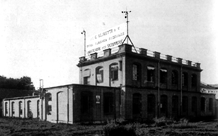 |
| Camillo Olivetti | The first factory |
Olivetti grew rapidly, building up a diversified product offer and opening subsidiaries in Europe and the rest of the world. In 1920 , the company presented the M20 typewriter; by the end of the 1920s, thanks to new forms of labour organisation and the introduction of mass production, it reached an annual output of 13,000 machines. While the number of sales branches multiplied in Italy, the company began its international growth, opening its first overseas subsidiary in 1929, in Spain, which was followed by operations in Belgium, Argentina and a number of other European and South American countries. Typewriter production expanded with the introduction of new models, including the first portable typewriter, the MP1, launched in 1932. During the 1930s and 1940s , Olivetti moved into teleprinters, calculators, office furniture and fittings. It also manufactured electric typewriters and calculators and began production of numerical controls.
New manufacturing facilities were opened in Italy and, as from 1930, in other countries.
Adriano Olivetti: culture, growth, innovation
One of the key figures behind the company's rapid expansion was Adriano Olivetti , Camillo's son.
Appointed to the post of General Manager in 1932 and Chairman in 1938, Adriano established a corporate style and culture that won Olivetti a unique place in Italian and European industrial history.
 |
Adriano Olivetti |
 In 2001, to celebrate the centenary of the birth of Adriano Olivetti, Olivetti SpA, the Fondazione Adriano Olivetti and the Associazione Archivio Storico Olivetti organised an international conference "Building the Human City" and an exhibition "Adriano Olivetti and Town Planning". To mark the centenary, Olivetti produced and published the site Adriano Olivetti: Building the Human City
Adriano paid particular attention to technological development, innovation and product quality, and strengthened the company's international operations. His interest in industrial design laid the foundations for a tradition of excellence that continues today. The social issues of the workplace were another major concern, together with the relationship between the company and the local community. A multi-faceted personality - entrepreneur, intellectual, publisher and town planner with a keen interest in social problems - Adriano extended his activities well beyond the confines of the industrial world. He commissioned new factories, offices, employee housing, canteens and nurseries and developed a comprehensive system of social services.
Under Adriano Olivetti's leadership, the 1950s was a time of extraordinary growth, during which the company established itself as the undisputed leader in mechanical office product technology : its flagship products were the Lexikon 80 office typewriter introduced in 1948, the celebrated Lettera 22 portable typewriter launched in 1950 and the Divisumma calculator designed by Natale Capellaro in 1948 and renewed in 1956.
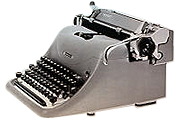 |  |  |
Olivetti Lexikon 80 M. Nizzoli - 1950 | Olivetti Lettera 22 M. Nizzoli - 1950 | Olivetti Divisumma 24 M.Nizzoli - 1956 |
In 1958, 50 years after its foundation, Olivetti had more than 24,000 employees, of whom approximately 10,000 in its 17 overseas subsidiaries; about 60% of production was exported. The expansion of the overseas sales and production operations was flanked in 1959 by the acquisition of Underwood, a major US typewriter manufacturer.
This period also saw the first major transformation in the company's history when, with great foresight, Olivetti invested in the new field of electronics . Realising that the new technology would revolutionise computing and office products, as early as 1952 Olivetti had opened a small R&D laboratory in New Canaan (Connecticut, USA); in 1955 it set up an electronics research lab near Pisa. Investments in electronics and the intensive work of the research team in Pisa drove the development of the Elea 9003, Italy's first electronic computer, which Olivetti presented in 1959. A device based entirely on transistors, the Elea 9003 placed Olivetti at the forefront of the world's computer manufacturers. Electronics seemed to be opening up a phase of exciting new growth.
The transition from electronics to information technology
|  |
| Olivetti Headquarters A.Bernasconi, A.Fiocchi, M.Nizzoli - 1962 |
But Adriano Olivetti's sudden death in 1960 and a series of problems, linked in part to the costly acquisition of Underwood and the heavy financial outlay needed to support the Electronics Division on a domestic market that was not yet ready for computers, led Olivetti into financial difficulties. The Olivetti family had retained control of the company when its shares were admitted for trading on the stock exchange in 1960, but in 1964 it opened up the capital to a group of banks and Italian manufacturing companies. The same year, the Electronics Division was spun off to a company owned jointly by Olivetti (25%) and General Electric (75%); in 1968 Olivetti sold its minority shareholding.
 | |
| The P101 desktop computer, design: M. Bellini - 1965 | |
Although the sale of the Electronics Division was a setback for Olivetti's growth and technological development, work in the computer field was not abandoned entirely: attention shifted towards smaller devices and distributed data processing. In 1965, Olivetti presented the P101, an innovative programmable desktop computer using magnetic cards. Widely regarded as the forerunner of the personal computer, the P101 was developed by a research team headed by Pier Giorgio Perotto.
The 1970s was an important time during which Olivetti invested heavily in the electronics field to acquire new technology and develop new personnel skills. On the production floor, the company introduced innovative organisational models, partly to deal with the problems created by the lower labour content of electronic products compared to mechanical products. The catalogue was enhanced with new accounting machines, teleprinters and printer devices, while the technology and design of Olivetti's traditional office products continued to evolve. But the move into the electronics business at a time of high inflation and high interest rates that hampered access to the stock markets took its toll. Growing international competition exacerbated the company's problems, and by the end of the decade Olivetti was in serious financial difficulties.
In 1978 Carlo De Benedetti bought a stake in the company and took over its management. The completion of the conversion to electronics, a stronger focus on new product development and a financial recovery achieved through a recapitalisation programme and improved management efficiency put Olivetti on a solid footing for a new cycle of growth.
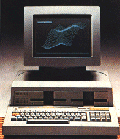 | |
| The M24 personal computer, design: E. Sottsass - 1982 | |
Key products launched at this time included the first electronic typewriter (the ET 101 in 1978) and the first personal computer (the M20 in 1982), followed two years later by the M24, an outstanding success throughout Europe and the United States.
These and other products and services consolidated Olivetti's second major changeover, the move into information technology , a field in which it subsequently established itself as the European leader.
During the 1980s , Olivetti stepped up its growth with international acquisitions, agreements and alliances, as well as a number of venture capital operations. A key alliance was formed with the American company AT&T at the end of 1983.
With its move into information technology, Olivetti introduced a succession of systems lines and also expanded into the IT services business. Its solutions were based on the principle of standard open systems - a policy that was subsequently adopted by all the top players in the international IT arena.
 | |  |
| Olivetti Open System Architecture: standard open systems | Olivetti Open System Architecture: distributed I.T. |
The office products offer was also enhanced, ranging from electronic word processing equipment and calculators to printers, fax machines, cash registers, photocopiers and office supplies. The development of bubble ink-jet technology opened up new business opportunities and paved the way toward fresh growth.
Olivetti and telecommunications
Perceiving the enormous potential of telecommunications , at the beginning of the 1990s , Olivetti and a group of investors (including some of the world's top telecoms operators) established Omnitel , to operate in the mobile communications field. After obtaining an operating licence, Omnitel began commercial service at the end of 1995: the start of an extraordinary success story. Similar strategic thinking lay behind the formation of Infostrada , a fixed-line telephone operator, in 1995. Within a few years, these two operations would transform Olivetti and project it into a new period of growth.
|


In the first half of the 1990s, growing global competition, falling prices and margins in the worldwide computer industry, and the weakness of the European market in general and the Italian market in particular forced Olivetti to implement a long and costly restructuring.
In September 1996 , a particularly difficult time for the company, under the leadership of Roberto Colaninno Olivetti embarked on a sweeping transformation to strengthen its position in telecommunications and re-organise its information technology business.
The change involved a series of new telecommunications alliances, most notably with Germany's Mannesmann group (1997), and the sale of the personal computer division (1997) and the systems and services operation (1998). With these disposals, the Group re-focused its IT business on a limited number of specific areas (office products; specialised systems; IT services for the Italian market), but achieved a business and financial recovery that enabled it to re-gain the confidence of the international financial community.

Roberto Colaninno then took action to strengthen Olivetti's shareholding structure and implement a new growth strategy in telecommunications. In February 1999, Olivetti and its Tecnost subsidiary announced their intention of launching a voluntary public tender offer on 100% of Telecom Italia ordinary shares. The operation closed in June with the acquisition of more than 52% of Telecom Italia ordinary stock, for an outlay of 31.5 billion euros. At the same time, in compliance with anti-trust regulations, Olivetti sold its equity in Omnitel and Infostrada to Mannesmann. Control of Olivetti passed to Bell S.A. , a Luxembourg-based company formed by a group of Italian financiers and industrialists.
The heavy burden of debt taken on to finance the tender offer, combined with falling share prices, especially among Internet and telecommunications stocks, led to further change. In July 2001, Bell reached an agreement to sell its controlling stake in Olivetti to the Pirelli and Benetton groups. As a result of this transaction, which closed in September 2001, the Olimpia company, held by Pirelli, Edizione Holding (Benetton group), Intesa-BCI and Unicredito, became Olivetti's majority shareholder, with a stake of almost 29%. The appointment of the new chief executives officers Marco Tronchetti Provera and Carlo Buora marked the start of a new phase that sees the Olivetti company strongly focused on the telecommunications business through the companies in the Telecom Italia group, with management of its operations co-ordinated closely with that of Telecom Italia group.
In March 2003 the plan to merge Telecom Italia by incorporation into Olivetti was announced with the aim of simplifying the structure of the Group, consistent with the market's wishes. The merger plan was approved by the respective Shareholders' meetings of Telecom Italia and Olivetti on 24 and 26 May 2003.
Following the merger, which became effective from 4 August 2003, Olivetti changed its company purpose and adopted that of Telecom Italia as well as adopting the Telecom Italia name .
The identifying details of the new “Telecom Italia” are:
Telecom Italia S.p.A.
Registered office in Milan, Piazza degli Affari no. 2
Share capital Euro 8,845,640,599.40
Tax number and Milan Companies Register Number 00488410010
Chairman: Marco Tronchetti Provera
Vice-Chairman: Gilberto Benetton
Chief Executive Officers: Carlo Buora and Riccardo Ruggiero
General Managers: Riccardo Ruggiero and Giuseppe Sala
 Palazzo Uffici 1 (PU1) in Ivrea, head office of Olivetti SpA . Designed in 1962 by architects G.A. Bernasconi, A. Fiocchi and M. Nizzoli, PU1 is still an interesting example of office architecture today
 Palazzo Uffici 2 (PU2) in Ivrea
built next to PU1 in 1988 from a project by architect Gino Valle
 The facade of the Nuova ICO factory
in Ivrea designed by L. Figini and G. Pollini in 1949

The Olivetti Technical Centre and Warehouse
in Yokoama, Tokyo (Japan), designed by Kenzo Tange in 1970

The towers of the Olivetti office building in Frankfurt
(Germany) designed by Egon Eiermann (1972)
Ett av Sveriges mest inarbetade Windows kassasystem täcker de flesta företags behov.
Med en användarvänlig mjukvara och en driftsäker hårdvara är du snabbt igång.
I paketet ingår bl.a. dator, koppling till kontokortsmaskin, kvittoskrivare, kontrollenhet.
Moduler & Funktioner som ingår
 Snabb knappar |  Fler Betalmedel |  Sök Funktion |  Returer |  Rabatter |
 Parkera Kvitto |  Kundregister |  Logotyp på kvitto |  Mix & Match |  Bordskarta |
 Bongskrivare |  Scanner koppling |  Personalliggare |  Bokningskalender | |
 Lagerhantering |  Rapporter Tim,Dag,mån,År |  Statistik |  SIE-Export |  Kampanj |
| Tillval | ||||
 Rum & Förvaringsplats |  Backoffice |  Mobile Order |  SMS Kampanj |  SMS Kvitto |
 | Stöd för flera företag (Flera organisationsnummer) Stöd för obegränsat antal företag utan extra kostnad. |
| Snabbknappar Tilldela enkelt dina mest sålda produkter en egen snabbknapp för snabb hantering. Funkar utmärkt med touch-skärm! |
| Digitala kvitton Välj mellan att skriva ut kvittot eller spar på miljön genom att istället maila kvittot till kunden. |
| Streckkodsläsare Skanna dina varor med streckkodsläsare för att spara tid vid kassan. |
| Presentkort Sälj presentkort för att få återkommande kunder! Ange ett presentkortsnummer eller låt kassan skapa ett själv. Saldot sparas och justeras i kassan efter användning. |
| Parkera kvitto Spara ett påbörjat köp i minnet, som sedan snabbt går att hämta upp. Fortsätt med andra köp under tiden! |
| Kunddisplay Komplettera ditt kassasystem med en snygg, modern 7″ LCD-display, vänd mot kunden som visar kvittot i realtid. |
| Kassakopplade kortterminaler Stöd finns för kassakopplade kortterminaler från Nets och Verifone. |
| Artikelregister/Lager Med Online har du full koll på ditt artikelregister och lager! Dra ut lagerrapporter, genomför inventering och få ut listor på vilka produkter du börjar få slut på. Skriv ut prisetiketter för dina artiklar direkt på din etikettskrivare. |
| Externa betalmetoder – ex. Swish! Lägg till egna betalmetoder i kassan, såsom Swish. När kvittot skapas står namnet på betalmetoden och du får rätt underlag för bokföringen. |
| Kampanjvaror Ställ in kampanjpris på utvalda varor. Gäller ett visst antal varor eller en viss tidsperiod. |
| Fler kassor Har du behov av flera kassor i lokalen? Eller en lösning för butikskedja? Inga problem! |
| Webshopsintegrationer Synkronisera och håll lagret uppdaterat automatiskt mellan butiken och webshopar från Shopify, Wikinggruppen, WooCommerce och Abicart. |
| Fjärrsupport Behöver du hjälp? Ring programutvecklarna så ansluter de direkt till din kassa och löser ditt problem. Givetvis nås de per telefon och e-post för support och övriga frågor, alla vardagar. |
| Integration mot affärssystem Automatisera din bokföring genom att skicka in din bokföringsdata direkt i affärssystemet. För närvarande stöds Fortnox och Hogia affärssystem. |
| Digital bokföring Använd funktionen för att exportera SIE-filer direkt till ditt bokföringstid istället för att skriva ut dagsrapporter på papper. Sparar tid och gynnar miljön! |
| Bokföringskonton Använd existerande kontoplan, eller lägg till egna konton för bokföring. |
| Molnbaserad backoffice Administrera dina artiklar, håll koll på ditt lager och dra ut dina rapporter från soffan genom det molnbaserade administrationssystemet Back office. |
GÅ ALDRIG MISTE OM EN FÖRSÄLJNING Ta emot kontanter, kort, Swish,och fakturabetalningar samt följ skattereglerna från dag ett med vårt kassaregister. | ALLT PÅ ETT STÄLLE Organisera dina produkter, håll koll på lagret och lagra dina försäljningsuppgifter tryggt. | |
iPoz Win10 | ||
Övriga funktioner m.m.
Anslutningsbara tillbehör: Cash guard/Cloudsafe Distans supportmodul |  iPoz -GO PRO | |
Ta emot alla typer av betalningar, överalltMed iPoz Win10 får du alla verktyg du behöver för att ta betalt och öka försäljningen. Använd din enhet till att ta emot kort-, kontant- och skicka fakturabetalningar samt Swish, | ||
Transaktionskostnader |  | |
GÅ ALDRIG MISTE OM EN FÖRSÄLJNING Ta emot kontanter, kort, Swish,och fakturabetalningar samt följ skattereglerna från dag ett med vårt kassaregister. | ALLT PÅ ETT STÄLLE Organisera dina produkter, håll koll på lagret och lagra dina försäljningsuppgifter tryggt. | |